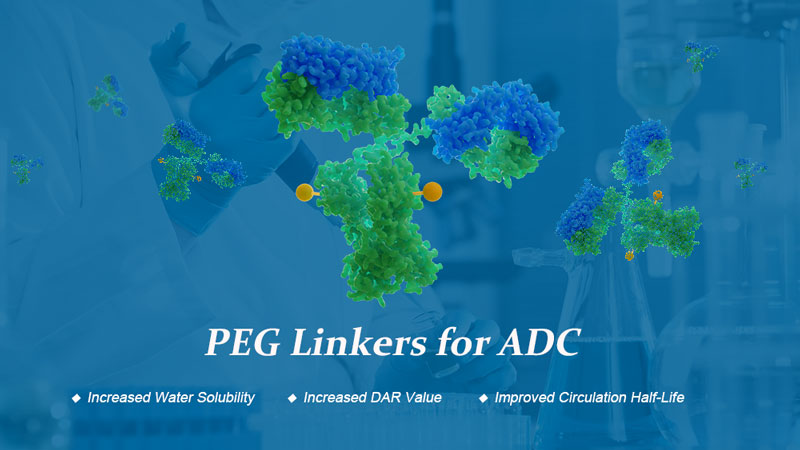
ADC (antibody-drug conjugate) drug consists of a monoclonal antibody, a linker and an active drug. Through the binding of monoclonal antibodies to specific antigens on the surface of tumor cells, the cytotoxic drug is delivered to the tumor lesion in a targeted manner, which significantly improves the safety and efficacy compared to traditional chemical and biological drugs.
Mechanism of Action of ADC drugs
- ADC injected into the body binds to target cell surface antigens.
- The ADC-antigen complex enters the cell through lattice-protein-mediated endocytosis and is encapsulated in the endonucleosome.
- The intranucleosome fuses with the lysosome and the drug is degraded in the lysosome.
- The drug is released into the cytoplasm.
- DNA or microtubules are damaged.
- Apoptosis of target cells.
PEG and ADC Linker
Polyethylene glycol (PEG) is one of the most widely used linkers in targeted therapies. PEG linkers are highly utilized, highly targeted, and pH-regulated.
Role of PEG Linker in ADC
1.Increase water solubility, drug molecules are generally poor in water solubility, the addition of PEG in Linker structure can increase the water solubility of the whole molecule.
- Increase the DAR value (drug-to-antibody ratio) to improve the efficacy of ADC drugs on the basis of low toxicity.
3.Increase the circulating half-life of ADC
PEG Linker and Bispecific Antibody
Through the selection of multiple functional groups, PEG linkers can bind to different antibodies and drugs to form different linkers, such as PH-sensitive linkers, disulfide bonded linkers, β-glucosidic acid linkers, etc., thus achieving site-specific linkage, and then to achieve degradation and slow release. These are all forms of PEG binding to a drug target through one chemical linker. The emergence of PEG double linker technology, as a new generation upgrade of the traditional PEG single linker technology, not only makes the hard-to-breakthrough bispecific ADC a reality, but also makes triple immune-acting drugs possible.
PEG Linker for ADC Drugs
- Sacituzumab-govitecan (IMMU-132)
Trodelvy® (sacituzumabgovitecan-hziy) is marketed for the treatment of adult patients with unresectable locally advanced or metastatic triple-negative breast cancer (mTNBC) who have received at least two prior systemic therapies or at least one of them for metastatic disease. Sacituzumab-govitecan ( IMMU-132) is coupled to SN-38 via a cleavable maleimide linker with a short polyethylene glycolation unit.
- Zynlonta
The FDA approved Zynlonta, a drug targeting CD19, for the treatment of relapsed or refractory diffuse large B-cell lymphoma (r/r DLBCL), including patients who have been treated with stem cell transplantation and CAR-T cell therapy.
The ADC drug development track is hot, and many large companies at home and abroad have joined its ranks. Its market space is huge, and the quantity and quality of ADCs are expected to increase dramatically in the next decade simultaneously. Biopharma PEG will focus on ADC-Linker R&D and continue to help you develop your R&D projects.
About Biopharma PEG
Biopharma PEG, a leading customer-focused biotech company based in Watertown, Massachusetts, manufactures and supplies high quality PEG Linkers for clients worldwide. With a strong background and expertise in modern chemistry, innovative and novel PEG technology and state-of-the-art equipment, Biopharma PEG helps customers to accelerate their research through cost-effective and efficient solutions. We offer a series of PEGylated ADC linkers to our clients in ADC drug development.