The Export Promotion Capital Goods Scheme (EPCG Scheme) can be described as the ‘Duty-Free (Zero Customs Duty) Import of Capital Goods/Machinery for the manufacturing of products intended for export.’
These Capital Goods can be utilized across various stages, including production, pre-production, and post-production, for goods manufacturing. This program is also referred to as the zero-duty EPCG scheme. It’s common knowledge that businesses often grapple with hefty customs duties when importing capital machinery for production needs. Consequently, many opt for compromises in the quality of their goods.
The higher the machinery’s price, the greater the custom duty burden, negatively impacting the competitiveness and quality of the manufacturing industry. To address this challenge, the Government of India introduced a scheme permitting the import of capital goods with zero customs duty.
The EPCG Scheme was initiated to facilitate the importation of Capital Goods/Machinery, enhancing the production of high-quality goods and services. The primary objective of the EPCG Scheme is to enhance India’s competitiveness in the manufacturing sector.
What is the benefit of the EPCG Scheme?
The primary advantage of the EPCG Scheme lies in the ability to import capital goods without incurring any customs duties.
Eligibility criteria for applying under the EPCG Scheme
Exporters of any size can apply for benefits under the EPCG Scheme, regardless of their annual turnover.
EPCG licenses can be issued to the following categories of exporters:
- Manufacturer Exporters.
- Merchant Exporters who are supported by a manufacturer.
- Service Providers engaged in exporting services, such as those in the Hotel Industry.
Duties exempted under the EPCG Scheme include:
- Capital goods imported under the EPCG Scheme can be brought in with zero customs duty. It is important to note that as of March 31, 2021, IGST (Integrated Goods and Services Tax) and Compensation Cess are exempted. The government reserves the right to extend this exemption through notifications issued periodically.
- Capital goods under the EPCG Scheme can also be procured from domestic sources (i.e., domestic suppliers). In such cases, the applicable GST (Goods and Services Tax) for the supply is exempted.
Indigenous sourcing of capital goods is also permitted
Exporters have the option to procure capital goods from domestic manufacturers. These domestic manufacturers are eligible for deemed export benefits under paragraph 7.03 of the Foreign Trade Policy (FTP).
Who can apply for the EPCG Scheme?
The EPCG scheme is available for different types of exporters: Manufacturer Exporters, Merchant Exporters, and Service Providers.
EPCG Scheme for the Manufacturer Exporters
For Manufacturer Exporters, they can apply for an EPCG License. However, under this scheme, the Capital Goods imported have an actual user condition until the export obligation is fulfilled. This means that these capital goods cannot be sold or transferred until the export obligation has been met.
EPCG Scheme for the Merchant Exporters
Merchant Exporters, who are tied to a supporting manufacturer, are also eligible for an EPCG License. To obtain the license, the name and factory address of the supporting manufacturer where the capital goods will be installed must be endorsed on the EPCG License.
Additionally, when fulfilling their export obligation, the Merchant Exporter should mention the name and address of the supporting manufacturer on all shipping documents, such as the Shipping bill and Custom Invoice.
EPCG Scheme for the Service Providers
Service Providers are also eligible to apply for an EPCG License. This scheme allows various service exporters, such as Hotels, Tour Operators, Taxi Operators, Logistics Companies, and Construction Companies, to reduce their capital costs by importing or procuring capital goods duty-free through the EPCG scheme.
How does the EPCG License work?
- The import of Capital Goods must be completed within 18 months of acquiring the EPCG License. Revalidation of the EPCG Authorization will not be allowed.
- At the time of import, a bond or bank guarantee must be executed in accordance with applicable provisions with customs authorities.
- Following the installation of the Capital Goods, it is mandatory to obtain an installation certificate for the imported machinery from an independent Chartered Engineer, which must be submitted to DGFT.
- o encourage fast-track exporters, if 75% of the specific export obligation and 100% of the average export obligation are fulfilled in half or less than half of the export obligation period, the remaining obligation will be waived, and the EPCG License will be closed by the relevant authorities.
- Upon the completion of the export obligation, a redemption letter must be obtained from the regional authority of DGFT.
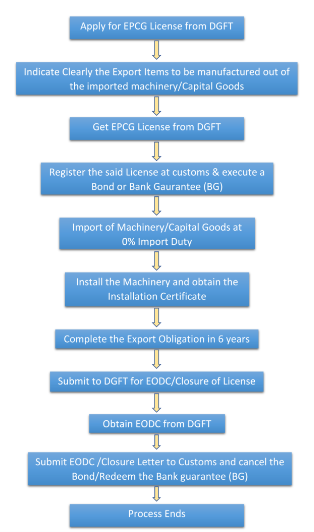
Working of EPCG License
How to apply for an EPCG License online?
To obtain an EPCG License, the applicant must complete an online application through the DGFT portal. Below are the steps to follow:
- Visit the official DGFT website at www.dgft.gov.in.
- Log in using your Digital Signature Certificate (DSC), then select ‘Services’ and choose ‘Online E-com Application.’
- Click on ‘EPCG (0%).’
- Provide all the necessary details and upload the required documents.
- It’s important to ensure the following points to prevent document errors:
- The IEC/RCMC must indicate the applicant as a manufacturer exporter.
- The IEC/RCMC should contain the address where the machine is proposed to be installed.
- The MSME/SSI/Manufacturing proof should list the export products specified in the EPCG License.
- Once you’ve filled in all the details, submit the application.
- After a successful submission, DGFT will issue the EPCG License.
Documents required for getting an EPCG License
To obtain an EPCG license from DGFT, certain documents are required. The following documents are necessary for the EPCG Scheme Online Application:
- Pro forma Invoice/Purchase order for the Capital Goods/Machinery.
- Copies of IEC, RCMC, MSME, Central excise registration, and GST Certificate.
- Details of Capital Goods to be imported, including HSN code, Name, Model Number, and Technical Description.
- List of Products that will be manufactured using the aforementioned machinery, along with their respective HSN codes.
- Chartered Engineer Certificate demonstrating the connection between the Capital Goods and the intended export products.
- CA Certificate disclosing the turnover for the last three financial years in both USD and INR, exclusively for the Export Products mentioned above.
- Factory Address where the machinery will be installed.
- Stepwise Process/Flow Chart illustrating the stages at which the capital goods will be utilized.
- Explanation of the end-use of Capital Goods in the production of export products, including the specific stages and methods of use.