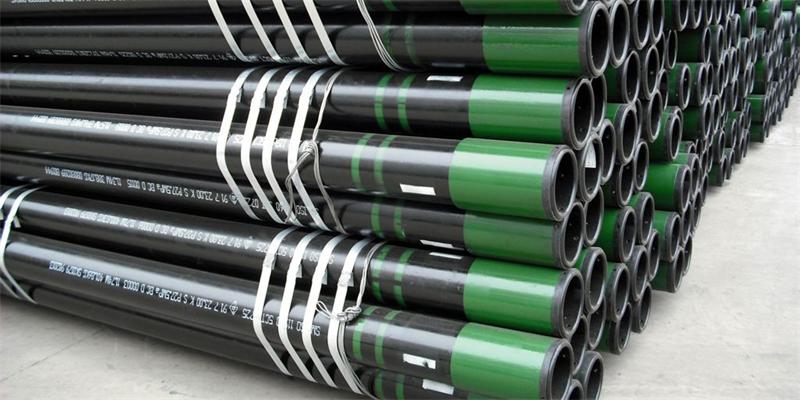
Cold-drawn seamless tube beveling involves forming an angle between the perpendicular plane surface and the pipe’s border. Generally, seamless pipe manufacturers follow a specific angle for beveling at 37.5 degrees. Using updated beveling machines, pipe fabricators can also produce J-bevels and other angular bevels.
Understanding beveling and its purpose:
A beveled pipeline rear is basically a joint surface with a specific beveled angle. Before processing two or more line pipes, pipe producers form an angle using bevel machines. The beveling of tubes and pipes is commonly employed to design the ends for welding. It can also be employed for deburring the cut ends for safety and aesthetics.
Calculating the bevel edges is deducting the thickness of the walls of seamless pipes from their exterior diameter. For instance, suppose a pipe has a diameter of seven inches, and the wall thickness of the pipe is three inches. Then, you have to deduct three from seven to get the thickness of the bevel. So, the bevel will be five inches.
Comparing different types of bevel ends:
Based on the users’ requirements, manufacturers can create bevel ends situated at different angles. Each bevel end has its own use and can improve the welding joints. Primarily, users choose four bevel ends for butt joints. These are Single—V bevel end, I—type butt joint bevel, Single U—bevel end, and Double—V beveled end.
Different varieties of the bevel end for cold-drawn seamless tubes:
Among all the bevel ends, the most common one is Single-V bevel end. Most users typically choose Single-V bevel end for butt joining pipes and tubes. Manufacturers can use this bevel end for 3 to 26 mm thick pipes. The bevel angle in this particular type is between 40 to 60°. Therefore, beveling machines are ideal for processing Single-V beveling.
However, Single-V beveling is more expensive than other bevel types because manufacturers need to produce more filter materials for this type of beveling. Although costly, the Single-V bevel is stronger and the best choice for square joints. The biggest drawback of this beveling is that it gets deformed when used in angular butt joints.
I-type butt joint for seamless tubes and pipes is the easiest to create and is ideal for pipes with 1 to 6 mm thickness. I-type butt joints are not typically beveling ends because the manufacturers create the ends to connect to parallel edges of pipes instead of connecting pipes in angles.
Even though I-type butt joints are easy and inexpensive to produce, manufacturers do not recommend using this type of bevel end. The I-type beveling end is not suitable for thick pipes, nor does it provide any support. To ensure the support and safety of thicker pipes, pipe fabricators must consider the pipe walls’ angles and thickness. Hence, they prefer using filler materials to provide welding solutions.
Some users require single-ended joining for the pipes they use. For those, manufacturers offer Single-U beveling ends. Single-U bevel ends do not deform as much as I-type butt joints. Therefore, they require fewer filler materials. However, the radian shape of the bevel ends makes it challenging to produce, so these cost more than I-type butt joints.
Double-V bevel ends are also known as X-joints. Double-V joints are ideal for standard tubes and pipes. However, double-V bevel ends must be welded on both sides. Hence, cold-drawn seamless tube fabricators must weld both sides one by one. As a result, it takes more time to produce Double-V bevel ends in comparison with any other bevel ends.
Double-V bevel ends are ideal for pipes with 12 to 60mm thicknesses. Even if the pipes are less thick, manufacturers can customize the beveling ends to meet the users’ requirements as per their industry. In fact, Double-V ends can be applied to join the two ends of pipes with any diameter and wall thickness.
Different types of pipe ends:
There are three standard versions available for the ends of pipes. These are as follows:
Plain Ends of PE pipes: Plain end pipes are seamless tubes and pipes with smaller diameters. These pipes are connected using socket welding and slip-on flanges.
Threaded Ends or TE pipes: Threaded end pipes have smaller diameters than PE pipes. As a result, manufacturers can join the pipes using threaded fittings and flanges.
Beveled Ends or BE pipe ends: Beveled ends are for butt-welding fittings and flanges. Manufacturers produce BE pipes to directly weld pipes with small gaps of around 3-4mm. BE ends have an angle of 30° and a root face of 1.6 mm (± 0.8 mm).
Conclusion:
When manufacturers join two or more pipes in angles, the joining angle is the beveled end. The term “beveled face angle,” typically used for single-U type pipes, describes the angle manufacturers form between the beveled surface and the vertical line leading to the pipe. The root opening refers to the space between both components’ roots before welding.
A single-U beveled end’s root radius widens the horizontal gap between the bases, enabling welding to penetrate all the way to the cold-drawn seamless tube root’s base. Steel tubes and pipes can be perfect if manufacturers perform beveling operations expertly. The pipe bevelling process is integral to manufacturing steel and alloy pipes and tubes.