Moisture-sensitive materials require controlled storage to maintain their quality, stability, and performance. Even small amounts of water vapor can affect hygroscopic chemicals, electronic components, laboratory reagents, and precision instruments. Choosing the right storage equipment helps you minimize moisture exposure, protect valuable samples, and maintain consistent laboratory workflows.
To select the appropriate cabinet, you need to evaluate your materials, storage conditions, vacuum requirements, and handling procedures. Understanding these factors helps you determine which cabinet design supports your application without adding unnecessary complexity or operating costs.
Identify the Moisture Sensitivity of Your Materials
Start by identifying the materials you intend to store. Different substances absorb moisture at different rates, and their storage requirements can vary considerably.
For example, hygroscopic powders may absorb atmospheric moisture quickly, while electronic components can experience performance degradation when exposed to excessive humidity. Some laboratory reagents also require specific environmental conditions to maintain their chemical properties.
Create a list of your materials and document the following information:
- Moisture sensitivity and acceptable humidity limits.
- Recommended storage temperature.
- Compatibility with reduced-pressure environments.
- Required storage duration.
- Packaging requirements and handling frequency.
Review the manufacturer’s storage instructions before selecting equipment. This assessment helps you determine whether vacuum storage is appropriate or whether a conventional desiccator cabinet would meet your needs.
Evaluate Vacuum Requirements and Material Compatibility
Vacuum performance is an important consideration when selecting equipment for moisture-sensitive materials. Reducing the pressure inside a suitable chamber can help remove air and moisture, depending on the material, packaging, and operating procedure.
However, not every material benefits from the same vacuum level. Some powders may release gases, volatile compounds may evaporate, and sealed containers may deform under pressure differences.
Before choosing a cabinet, establish the vacuum level recommended for your application. Check the equipment’s achievable operating pressure, pressure stability, chamber sealing performance, and compatibility with your intended vacuum source.
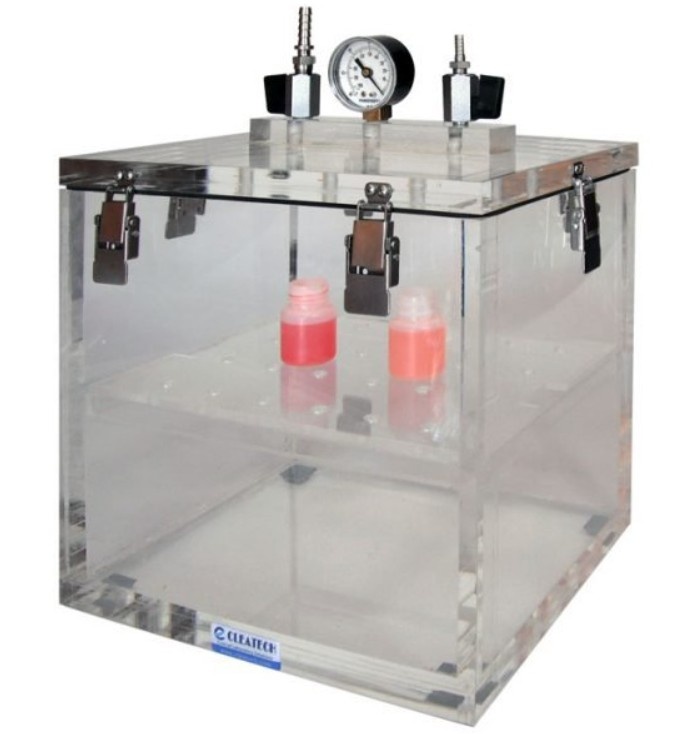
A properly selected vacuum desiccator cabinet for moisture-sensitive laboratory materials can support controlled storage when its operating specifications match your material requirements.
Remember that a vacuum-rated cabinet does not automatically guarantee a specific moisture level. Your results also depend on the initial moisture content, desiccant condition, leakage rate, sample packaging, and storage duration.
Choose Materials of Construction Carefully
The cabinet’s construction materials influence durability, cleaning requirements, and compatibility with the laboratory environment.
Consider these factors when comparing designs:
Chemical compatibility: Ensure the cabinet’s interior, seals, shelves, and fittings tolerate the chemicals or vapors associated with your application.
Structural integrity: Confirm that the chamber is designed for its specified vacuum conditions.
Seal performance: Select suitable gaskets and door seals that maintain a reliable vacuum over the required period.
Cleaning requirements: Choose surfaces that support your laboratory’s cleaning procedures.
Visibility: Transparent doors or panels can make it easier to inspect stored materials without opening the chamber.
Stainless steel may be suitable for applications requiring durability and straightforward cleaning, but its suitability depends on the chemicals present. Polymer components and elastomeric seals also require application-specific compatibility checks.
Prioritize the complete cabinet assembly rather than judging suitability by the enclosure material alone.
Determine the Required Storage Capacity
Cabinet capacity should reflect both your current inventory and expected laboratory demand. An undersized cabinet can create overcrowding, restrict access, and complicate sample organization. An oversized unit may occupy valuable laboratory space unnecessarily.
Estimate the number, dimensions, and packaging types of the items you plan to store. Then consider shelf spacing, usable chamber volume, and the clearance needed for safe loading and unloading.
For effective storage management, group materials according to compatibility, handling frequency, and environmental requirements. Keep samples organized so that frequently accessed items can be retrieved without disturbing the entire inventory.
When comparing a vacuum desiccator cabinet for organized laboratory sample storage, review internal dimensions and shelf configurations alongside the stated external dimensions. Confirm that the equipment fits your workspace and can be positioned where utilities, maintenance access, and operating procedures can be accommodated.
Consider Desiccants and Moisture-Control Methods
Vacuum storage and desiccant-based moisture control are related but distinct functions. A vacuum reduces chamber pressure, while an appropriate desiccant can capture residual water vapor. Depending on the application, these approaches may be used together.
Select a desiccant based on its moisture capacity, regeneration requirements, chemical compatibility, and suitability for the stored materials. Replace or regenerate it according to the manufacturer’s instructions.
You should also determine how moisture control will be verified. Options may include compatible humidity indicators, calibrated sensors, or documented moisture measurements appropriate to the application.
Avoid assuming that maintaining a low chamber pressure alone proves that the material remains dry. Establish measurable acceptance criteria and record relevant conditions during storage, especially when working with sensitive or high-value samples.
Review Safety, Maintenance, and Operating Procedures
Vacuum equipment must be designed for the pressure conditions under which it will operate. Never use an ordinary storage cabinet as a vacuum chamber unless the manufacturer specifically rates it for that purpose.
Before installation, review the equipment’s maximum allowable vacuum, operating instructions, inspection requirements, and maintenance schedule. Inspect seals, doors, fittings, and vacuum connections regularly.
Develop standard operating procedures covering loading, evacuation, pressure release, cleaning, and sample retrieval. Allow the chamber to return to a safe pressure before opening it, following the manufacturer’s instructions.
If your materials release hazardous vapors or contain volatile substances, assess the exhaust arrangement and vacuum-pump compatibility. Appropriate traps, filtration, or other controls may be necessary, depending on the substances involved.
Compare Specifications Before Making a Purchase
Create a comparison checklist to evaluate potential cabinets against your laboratory’s requirements.
| Evaluation Factor | What to Verify |
| Vacuum performance | Required pressure and pressure stability |
| Moisture control | Desiccant compatibility and verification method |
| Construction | Chemical resistance and structural suitability |
| Capacity | Internal volume, shelf layout, and sample dimensions |
| Sealing | Gasket compatibility and leakage performance |
| Maintenance | Inspection, cleaning, and replacement requirements |
| Documentation | Technical specifications and operating instructions |
Compare these factors against your application rather than selecting equipment based on price or capacity alone.
Working with an experienced laboratory equipment supplier can help you identify relevant specifications and clarify application-specific questions. CleaTech LLC provides laboratory and cleanroom equipment solutions that can help you explore suitable storage equipment for your workflow.
Conclusion
Matching vacuum desiccator cabinets to moisture-sensitive materials requires more than selecting a chamber with sufficient space. You must consider moisture sensitivity, vacuum compatibility, construction materials, storage capacity, desiccant requirements, and operating safety.
By defining your storage conditions before purchasing, you can make a more informed equipment decision and establish a repeatable moisture-control process. Review the technical specifications carefully and confirm that the selected cabinet supports your materials and laboratory procedures.
For assistance evaluating your requirements, Contact us today to discuss your laboratory storage application and identify suitable equipment options.
Frequently Asked Questions
1. What materials can you store in a vacuum desiccator cabinet?
You can store suitable hygroscopic chemicals, laboratory samples, electronic components, powders, and other moisture-sensitive materials. Confirm that each material, its packaging, and any associated volatile compounds are compatible with the cabinet’s operating pressure.
2. How do you choose the right vacuum level for moisture-sensitive materials?
Start with the material manufacturer’s storage recommendations and determine the required operating pressure. Consider evaporation, outgassing, packaging limitations, and the cabinet’s rated performance before establishing an operating procedure.
3. Is a vacuum desiccator cabinet better than a standard desiccator cabinet?
A vacuum model can provide reduced-pressure storage when the application requires it. A standard desiccator cabinet may be sufficient for materials that need controlled low-humidity storage without evacuation. Your choice should depend on moisture sensitivity, operating requirements, and safety considerations.
4. Do you need a desiccant inside a vacuum desiccator cabinet?
A desiccant may help capture residual water vapor, depending on the cabinet design and application. Follow the manufacturer’s recommendations and establish an appropriate replacement or regeneration schedule rather than assuming every vacuum storage process requires the same desiccant.
5. How can you maintain moisture control during long-term storage?
Inspect seals and fittings, maintain the vacuum system according to the manufacturer’s instructions, and monitor relevant environmental conditions. Use compatible moisture indicators or measurement devices, document inspection results, and minimize unnecessary chamber openings.
6. What should you check before purchasing a vacuum desiccator cabinet?
Verify the operating pressure, usable capacity, construction materials, sealing performance, chemical compatibility, moisture-control method, and maintenance requirements. Also confirm that the cabinet is designed for vacuum service and meets your laboratory’s safety and storage requirements.